
After two decades insulating homes across the Phoenix metro, one of the most common calls we get that has nothing to do with energy bills is noise: a shared bedroom wall that carries every word, a garage workshop that wakes the house, a home office next to a busy street. When we asked Chris Kuhn, our owner, what he wants pushed for these jobs, his answer came back in three texts: "I'd rather push Spray Foam", "Or simple attic touch ups by adding", and "Open cell market for me". That is exactly how we build these jobs — open-cell spray foam as the default, and a simple attic top-up as the lighter first move. Here is why, and where each option earns its place.
Quick Answer: The Insulation We Push for Noise
No insulation makes a room soundproof. What insulation does — when chosen and installed correctly — is absorb sound energy inside the wall or ceiling cavity and cut the airborne noise that passes through. For Arizona homes our default is open-cell spray foam, and this is how the materials we install compare for noise control:
| Material | How it handles sound | Best use |
|---|---|---|
| Open-cell spray foam | Expands to fill every gap, seals the air paths sound rides, and its soft open structure absorbs airborne noise | Interior walls, rooflines, media rooms, shared bedroom walls — our default push |
| Attic top-up (blown-in) | Adds mass over the ceiling plane and quiets roof-line and HVAC noise | The lighter first job when walls are not the problem |
| Dense-pack cellulose | Packed tight at high density, adds real mass and absorbs vibration | Existing closed walls, retrofit noise control |
| Mineral wool batts | Dense, non-flammable batts with strong sound absorption | Stud bays around home offices, studios, mechanical rooms |
| Closed-cell spray foam | Excellent thermal performance, rigid and dense but less absorptive than open cell | Where moisture or structure demand it — exterior walls, garages that get hose-downs |
The pattern to notice: for pure noise control, softer, fully-filling materials that also seal the cavity win. That combination is exactly why open cell leads. The Department of Energy's guide to home insulation covers how each material behaves for heat; sound follows density, coverage and air-sealing just as much as thickness.
Why Open-Cell Spray Foam Is the Smart Default in Arizona
Sound rides air. Before any material absorbs anything, the gaps in a wall — around outlets, at top plates, through duct penetrations — are highways for noise. Open-cell spray foam is the one product that handles both problems in a single pass: it expands to fill the cavity completely, sealing those gaps, and its soft, open-cellular structure then absorbs the airborne sound that reaches it. Batts can't seal; dense-pack adds mass but leaves the framing connected; closed-cell foam seals but its rigid structure absorbs less.
In an Arizona home the same application also does thermal work — a sprayed roofline or wall brings the space under the insulation envelope, which is why open cell is our usual answer for the rooms people actually live and work in: converted garages, casitas, home offices, bedrooms that share a wall with a noisy room. On a spray day the cavities get filled and the air paths get closed in one shot, and the depth is checked cavity by cavity.
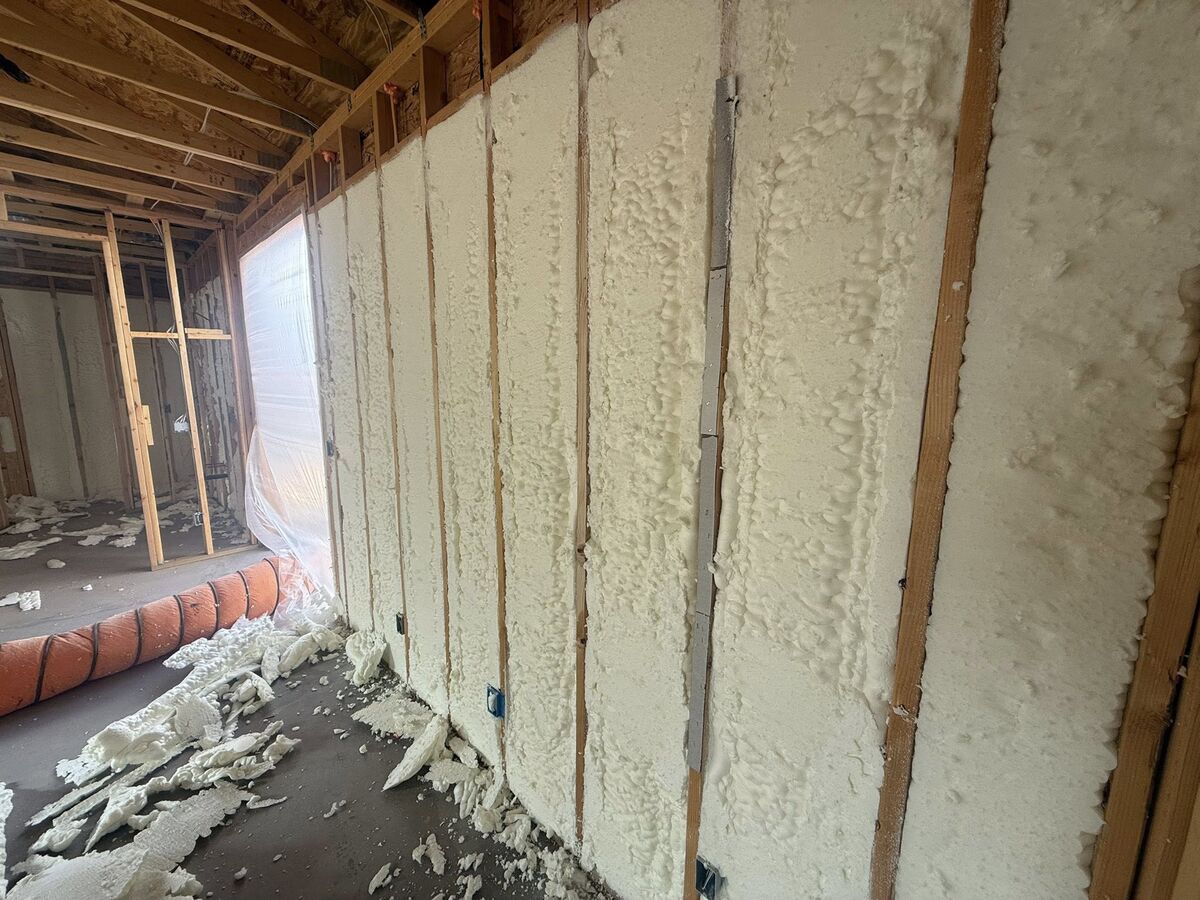
Closed cell still has its seat at the table — exterior walls and garages where moisture, hard use or structural demands call for a denser product. But for quiet, open cell is the market, and it is where we start.
The Lighter First Job: A Simple Attic Touch-Up
Not every noise complaint needs a spray rig. The second push on our list is the simple attic touch-up: topping up the insulation you already have with blown-in material, so the ceiling plane carries more mass and the roof-line racket — monsoon wind, HVAC equipment, the 2 a.m. roof pops of a desert cooldown — lands on insulation instead of drywall.
An attic top-up is the cheaper, faster job, and in a house whose attic has settled or was never filled properly, it is often the highest-value insulation spend you can make: quieter rooms below and a cooler house in the same afternoon. We measure what is there first, because depth is the whole game.
If your noise problem is a shared wall or a room next to the street, the attic will not fix it — that is a wall-cavity job, usually open cell or dense-pack. But if the noise comes from above or from the equipment in the attic, the touch-up is the smart first move.
Why Insulation Alone Is Not the Whole Fix
Sound travels two ways through a wall: through the air that leaks through gaps, and through the structure itself. Insulation only treats the first path well.
The three things that actually cut noise
- Air sealing — sound rides air. Every gap around outlets, top plates and duct penetrations is a highway for noise. Air sealing comes first, before any insulation decision.
- Mass — heavier assemblies block more sound. Dense-pack and mineral wool add mass inside the cavity; a second layer of drywall adds far more.
- Decoupling — separating the two wall surfaces so vibration cannot pass straight through studs. That is framing-level work, and it is the only fix for heavy impact noise.
This is why a homeowner can add batts to a shared wall and still hear the neighbor's television: the drywall is still screwed to the same studs on both sides, and the studs carry the vibration. Open-cell foam softens what the cavity passes along and seals the air paths, but it does not replace decoupling when the problem is structure-borne noise.
Noise is also a health and comfort issue, not just an annoyance — chronic noise exposure is linked to stress and sleep disruption, which is why workplace noise has its own federal standards. Your home deserves the same consideration.
What We Install for Noise, Room by Room
Shared interior walls
Open-cell spray foam is our usual answer here. Because it expands to fill the cavity completely, it seals the gaps that carry voices and absorbs airborne sound in one pass. Dense-pack cellulose is the retrofit option when the wall is already closed: we drill, pack the cavity tight, and patch.
Garages, workshops and shops
A garage you actually work in — or the one under a bedroom — needs insulation that handles heat and noise together. Open-cell spray foam on the walls and roofline turns a metal oven into a usable, quieter room; closed cell goes in where the space gets moisture or real abuse.
We explain the material trade-offs in more depth in our spray foam vs fiberglass comparison.
Home offices and media rooms
Open-cell spray foam in the stud bays plus careful air sealing around outlets and can lights is the package we push. Mineral wool batts are the alternative where the framing is already open and a batt fits the budget. If the room backs a street or a neighbor's AC equipment, we treat that exterior wall thermally at the same time — see our wall insulation service page for how we handle closed cavities.
Sound vs Heat: An Arizona Note on R-Values
One confusion we run into constantly: R-value is a thermal rating, not a sound rating. A product with a high R-value is not automatically quiet, and the quietest cavity fill is not automatically the best thermal barrier — which is why we often split the job: thermal insulation on the exterior envelope, sound-oriented material inside. The higher the R-value, the greater the insulating power. Ask your seller for the fact sheet on R-values — that disclosure is a federal rule, not a courtesy.
What a Noise Job Looks Like, and What It Costs
We will not quote a soundproofing job sight-unseen, because the right fix depends on things we can only see in the wall: how the framing runs, what is in the cavity now, where the air — and sound — is leaking. When we come out we check the assembly, listen to where the noise actually enters, and lay out options by cost and expected difference. The same visit settles whether an attic top-up or dense-pack belongs in the plan, since noise complaints and heat complaints often share one root cause: a leaky, under-filled envelope. The EPA's indoor air quality resources are a good parallel read on why sealing a house changes more than your power bill, and the Energy Department's insulation and air-sealing walkthrough shows the same sealing-first order we follow on every job.
If noise is wearing your household down, get a quote or call us at 623-241-1939. We will tell you plainly what insulation can and cannot fix in your walls — no overselling.
Frequently Asked Questions
What is the best insulation for soundproofing a wall? For interior walls, open-cell spray foam is our default: it fills the cavity completely and seals the gaps that carry sound in one pass. Dense-pack cellulose is the retrofit pick for closed walls, and mineral wool is excellent where batts fit. The material matters less than full coverage plus air sealing.
Can insulation make a room completely soundproof? No. Insulation reduces airborne noise passing through a cavity. Full soundproofing also needs mass (extra drywall), decoupling of the wall surfaces, and sealed gaps — and impact noise like footsteps needs structural fixes, not insulation.
Does spray foam help with noise? Yes. Open-cell spray foam in particular both fills the cavity and seals the small gaps that carry sound — it is the product we push most for noise complaints. Closed-cell foam helps too, though its rigid structure absorbs less than open cell, so we usually reserve it for exterior walls and garages where heat and moisture dominate.
Is an attic top-up good for noise? It helps with noise from above — roof-line racket, wind, and HVAC equipment in the attic — because it adds mass over the ceiling plane. It will not quiet a shared wall or street noise; that is a wall-cavity job.
Is fiberglass insulation good for sound? It helps some. Fiberglass batts are the budget option and do absorb some airborne sound, but they leave gaps and add less mass than dense-pack or mineral wool, so the improvement is modest.
How do I block noise from a shared wall in a condo or townhome? Combine cavity insulation (open-cell foam if open, dense-pack if the wall is closed) with a second layer of drywall on resilient channel, and seal outlets and trim. Insulation alone softens the noise; the added mass and decoupling are what cut it dramatically.
Does a higher R-value mean better soundproofing? No. R-value measures resistance to heat flow. Sound performance tracks density, coverage and sealing. Choose insulation for each job separately — thermal for the envelope, sound-absorbing materials for interior walls.
Will insulating my garage cut noise from the street? Usually yes, noticeably — especially with spray foam on the door-adjacent walls and careful sealing around the door itself. It also makes the garage usable in summer, which in Arizona is half the value.
How much does soundproofing insulation cost? It depends on the wall area, the material, and whether the wall is open or closed. We quote after seeing the space, because retrofit dense-pack and new-construction spray foam are priced differently. The estimate is free.