
Homeowners in the Phoenix area ask us some version of the same question almost every week: the house needs insulation, spray foam sounds like the premium choice, and the estimate mentions two kinds — open cell and closed cell — that nobody has explained. It is a good question to ask, because the answer changes what you pay and what your walls, attic and garage actually do in July. We have been spraying both kinds in Arizona since 2004, and the honest answer is that neither one is "better." They are different materials for different assemblies, and picking the wrong one for the wrong spot wastes money in one direction and performance in the other.
If you are comparing spray foam against fiberglass batts instead, we cover that separately in our spray foam versus fiberglass comparison. This article is the foam-versus-foam question.
Quick Answer: The Real Difference
Both products start as the same chemistry — a two-component polyurethane system sprayed by trained installers — but they cure into very different materials. Open-cell foam is low-density: the tiny cells burst open as it expands, leaving a soft, spongy, cream-colored foam that grows to fill a cavity completely. Closed-cell foam is denser and heavier: the cells stay closed and gas-filled, so it cures hard and rigid and expands far less. The U.S. Department of Energy's insulation overview describes both under the spray-applied foam family, and the industry's product library at SprayFoam.com shows how differently the two types behave — we spray UPC and Icynene systems, and every estimate includes the manufacturer's published product data for the exact system quoted.
Side by side, at a glance
- Open cell: soft, spongy, high expansion, vapor-permeable, fills big cavities fast — the usual choice for interior walls and attic rooflines.
- Closed cell: hard, dense, low expansion, resists moisture, adds rigidity — the usual choice for tight spaces, wet spaces, metal buildings and anything that has to take abuse.
- Both: spray-applied, adheres to the framing, and air-seals as a continuous layer — the single biggest advantage over batts.
One thing we will not do in this article is quote R-value-per-inch numbers, even though you will find them all over the internet. As an installer we follow the FTC's R-value Rule: R-value claims belong on the manufacturer's fact sheet for the product and thickness actually installed, not in a blog comparison. The higher the R-value, the greater the insulating power. Ask your seller for the fact sheet on R-values.
Where Open Cell Belongs
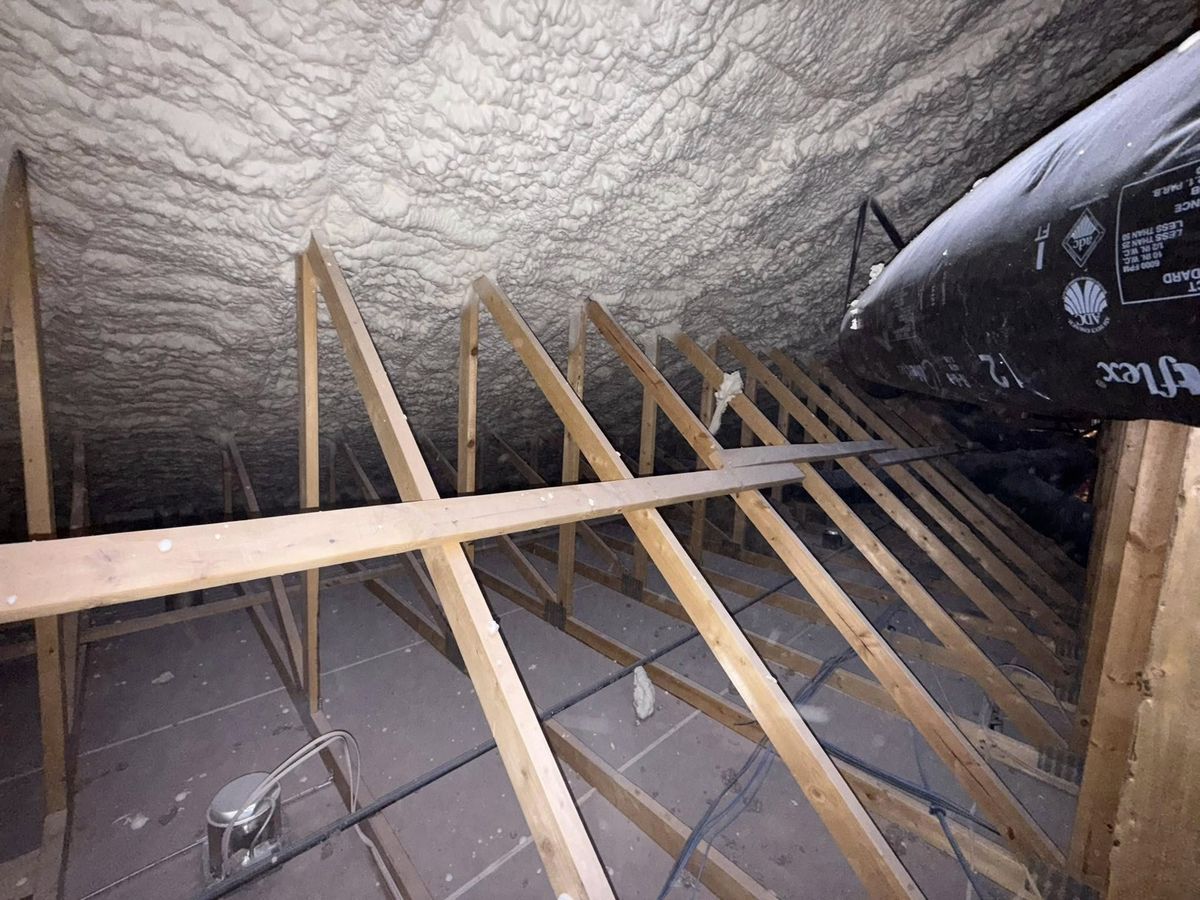
Open-cell foam is the volume player. Because it expands so aggressively, a crew can fill a 2x6 wall cavity or cover an entire attic roofline in fewer passes, which is part of why it is the more budget-friendly of the two. In Arizona its signature job is the unvented attic: spraying the underside of the roof deck and rafters brings the attic inside the thermal envelope, which matters when the ducts running through a Phoenix attic are sitting in 140-degree air all summer. That is the same attic problem we walked through in why your second floor stays so hot.
The second thing open cell does well is dry out. It is vapor-permeable — water vapor passes through it — so an assembly insulated with open cell can release moisture rather than hold it. The Building Science Corporation-style guidance compiled in the Building America Solution Center treats that drying ability as a design feature: in a climate with monsoon humidity, walls and rooflines that can dry are walls and rooflines that stay out of trouble. Open cell is also the better performer of the two for sound, which is why it shows up in our soundproofing work — the open cell structure absorbs sound energy instead of reflecting it.
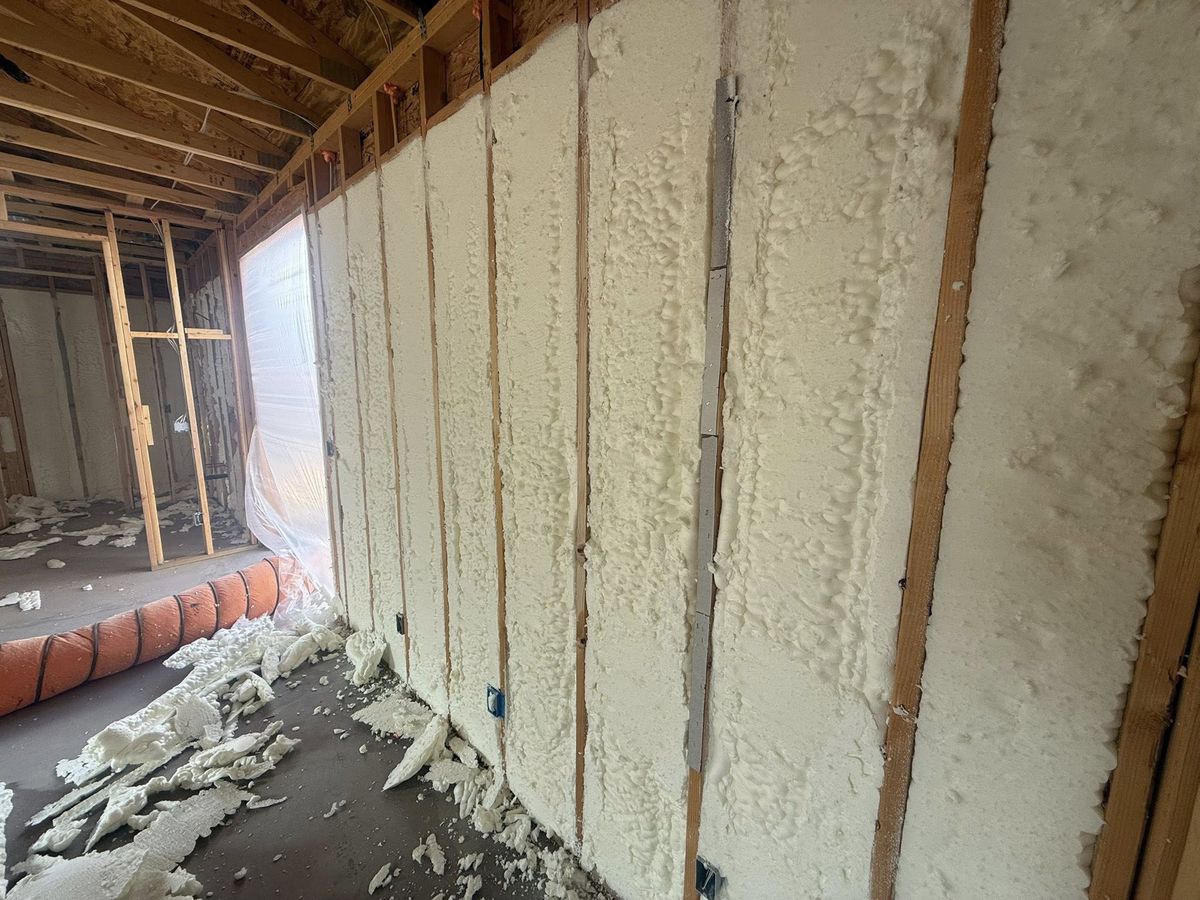
You can see the texture in the photo above: soft, slightly irregular, filling every bay and sealing around wiring and boxes. You can press a finger into it. That softness is not a defect — it is the open cell structure doing its job.
Where Closed Cell Belongs
Closed-cell foam is the specialist. It costs more per board foot because you are buying more material per inch of thickness and a slower, more deliberate install — but in the right place it is the only correct answer. Its closed cells refuse liquid water, so it earns its keep in crawl spaces, rim joists near grade, garage and workshop walls, exterior-facing assemblies, and the metal buildings and barns we insulate across the Valley. Our closed-cell spray foam and closed-cell product pages cover those systems in detail.
That density also buys rigidity. Manufacturers document rated rack and shear strength improvements for framing sheathed in closed-cell foam, and on a steel shed or a pole barn — where there is no house wrap and no cavity to fill — a thin, hard, self-adhering layer is exactly what the assembly wants. For tight spaces where you cannot afford to lose room depth (boat hulls, vans, ducts plenums and hard-to-reach cavities), closed cell's low expansion is the practical choice.
The Moisture Question (and the Mold Question)
Here is where internet research tends to go wrong. You will read that "open cell molds" or "closed cell traps moisture." Neither is quite true. Spray foam itself is not a food source for mold — mold grows on wet dust and organic material. What matters is where the water in an assembly goes. Open cell lets vapor pass and can absorb liquid water if the roof actually leaks — which makes leaks visible and findable, but means the leak must be fixed. Closed cell blocks moisture almost entirely, which is protection — unless the assembly was counting on drying through that path, a failure mode the Building America Solution Center covers in its insulation and air-sealing guidance.
In Arizona this is a real design decision, not a footnote: a vented attic behaves differently from an unvented one, and monsoon-season humidity moves through wall assemblies differently than dry May air. This is exactly the kind of call that should be made per-assembly by the installer walking your house, not off a chart.
Air Sealing, Certification, and Why the Installer Matters
Both foam types air-seal when applied as a continuous layer — that shared ability is why foam outperforms batts in leaky desert homes, and it is why air sealing is part of the conversation on every estimate we write. What separates a good foam job from a bad one is not the drum the material came from. It is ratio control, substrate temperature, lift thickness limits and flash timing — every manufacturer publishes them, and the Spray Polyurethane Foam Alliance maintains the industry's technical guidance for installers. We are Icynene-certified and an SPFA member, and every job we spray is done to the manufacturer's specification for that system, under our ROC license #335896.
Two-component foam is also a professional product in the safety sense: crews ventilate during application and follow manufacturer re-occupancy guidance before the family moves back in. A "cheap foam guy" bid that skips those steps is not a bargain.
Does Either One Lower Cooling Bills?
A tighter, better-insulated envelope generally means the air conditioner runs less — that is the whole point of the work, and it is why we write energy improvements up as a system rather than one product. But honest numbers depend on the house, the ducts, the shading and the thermostat, and we do not promise a specific figure for yours. Savings vary. Find out why in the seller's fact sheet on R-values. Higher R-values mean greater insulating power.
Frequently Asked Questions
Is closed cell or open cell spray foam better? Neither, universally. Open cell is the standard for interior walls and unvented attic rooflines in Phoenix homes — it fills large cavities economically, air-seals, and lets assemblies dry. Closed cell is the standard where moisture, tight space or surface strength matter: crawl spaces, garages, sheds, metal buildings. The assembly decides, not a ranking.
What are the downsides of closed cell spray foam? Cost is the big one — more material per inch of coverage and a slower install. It is also less forgiving of sloppy technique: lifts must go on within the manufacturer's thickness and temperature limits, and trimming a hard, rigid foam is slower than trimming soft open cell. Where an assembly needs to dry through the insulation, closed cell's low permeability is itself a downside.
How do I tell if I have open cell or closed cell spray foam? Press it. Open cell feels soft and spongy and is usually pale cream or yellow; closed cell is hard, dense and usually trimmed smooth, often a darker tan. Open cell typically overfills studs and is shaved flush; closed cell is applied in measured, thinner passes. The definitive answer is your installation paperwork — the manufacturer's fact sheet for the system installed.
Can mold grow on open cell foam? Not on the foam itself — polyurethane foam is not a food source. Mold appears when water gets into an assembly and sits on dusty or organic surfaces. Open cell can absorb liquid water from a real leak, which makes the leak visible so it can be fixed. Manage the water and the mold question answers itself.
Which spray foam is right for an Arizona attic roofline? For a typical unvented conditioned attic in the Valley, open cell on the underside of the deck and rafters is the common approach — full cavity fill, air-sealed roofline, assemblies that can dry, and the ducts end up inside conditioned space. Closed cell belongs on a roofline when the space is tight, bulk-water exposure is real, or the structure needs the rigidity. Every roofline gets evaluated, not assumed.
Is spray foam an air barrier? Both types are, when installed as a continuous adhered layer — the foam bonds to framing and sheathing and seals the gaps batts leave open. That continuous layer is what stops the hot attic and dusty outdoor air from moving through the building. ENERGY STAR's home sealing resources treat air sealing and insulation as two halves of the same job.
Does closed cell spray foam add structural strength? Yes, in a documented way: manufacturers publish rack and shear strength improvements for assemblies with closed-cell foam applied, and that rigidity is one reason it is the default on metal buildings and sheds. It is reinforcement, not a substitute for framing.
What does the difference cost? Closed cell generally costs more per covered area than open cell — more material per inch, more passes, slower work. What that buys depends on the assembly, so we quote it per job after looking at the house. The straightforward next step is a free estimate — we hold quotes for 90 days, and there is no pressure, just numbers you can compare.
The Short Version
If the job is big cavities, interior comfort and quiet — walls, attic rooflines, second-floor retrofits — open cell is usually the right spray foam for an Arizona home. If the job is moisture, tight spaces, metal buildings or abuse — crawl spaces, garages, sheds, barns — closed cell earns its price. And if anyone tries to sell you one by quoting a per-inch R-number off a chart, ask for the fact sheet instead. The ICC and code officials will.
Want a read on your own house? Get a quote or call us — we will tell you which assemblies on your property are open-cell jobs, which are closed-cell jobs, and which need nothing at all.