
Every Arizona summer we hear the same complaint from two-story households: the upstairs is ten degrees hotter than the downstairs, the upstairs AC runs nonstop, and the bedrooms nobody wants to sleep in are all on the second floor. It is not your imagination and it is not necessarily a broken AC — in a Phoenix-metro summer, a two-story house is fighting three stacked problems at once, and the attic is involved in all of them. Here is what actually makes the second floor hot, and the fixes we recommend, cheapest first.
Quick Answer: Why the Upstairs Is Hotter
Three forces stack against a second floor in Arizona:
- The attic above it turns into an oven. A dark roof under 110°F sun drives roof-deck and attic temperatures far above the outside air temperature. Whatever is between that oven and your bedrooms — thin insulation, air leaks, ducts leaking cold air into the attic — decides how much of that heat reaches the rooms below.
- Hot air rises (stack effect). Every bit of heat rising from the first floor — plus warm air pulled in through low-level leaks — collects at the top of the house.
- Ducts run through the hottest space in the house. In most Arizona two-story homes the ductwork lives in the attic. Cool air traveling through a 140–160 degree attic picks up heat on the way, and every seam that leaks is air-conditioning the attic instead of the bedroom.
The federal Residential Energy Consumption Survey shows nearly nine in ten Arizona households run air conditioning — the equipment works hard everywhere here. The difference upstairs is the envelope, not the effort.
The Attic Is the Whole Ballgame
On a July afternoon the roof deck over an uninsulated or under-insulated attic can run hotter than the desert air outside — dark shingle or tile absorbs the sun and radiates downward into the attic space all day. The National Weather Service's Phoenix heat pages describe how aggressively local surfaces heat up in summer; multiply that by a full roof and you get an attic that re-radiates heat into the second-floor ceiling well into the night.
That is why "why is my upstairs so hot at night" has the same answer as the daytime version: the attic stores the day's heat and keeps feeding it downward after sunset. The Department of Energy's Energy Saver guidance is blunt about the priority — the attic is usually the biggest single heat-gain path in a single-family home, and insulation plus air sealing up there is the first fix it recommends.
What we look for first
When we walk an attic for a hot-upstairs complaint, the checklist is short and it is the same one we would hand a neighbor:
- Depth. Is there actually insulation over every square foot of the second-floor ceiling, at the level this climate calls for? Settled, thin, or missing patches (a common find over additions and older remodels) let the ceiling plane conduct heat straight through. For context on how attic levels are even measured and disclosed, R-values are established under the federal R-value rule's testing requirements — and any R-value claim carries a required disclosure: The higher the R-value, the greater the insulating power. Ask your seller for the fact sheet on R-values.
- Air leaks. Recessed lights, attic hatch, bath-fan penetrations, wiring and plumbing chases — each one is an open path for attic air (and heat) into the room below. Air sealing is the DOE's first recommendation for a reason: insulation slows conduction, but it does nothing about moving hot air.
- Ducts. Are the second-floor supply runs intact, sealed and insulated where they cross the attic? A duct that leaks a fifth of its airflow into the attic delivers a fifth of nothing to the room it feeds. This is also why an upstairs that "was always like this" can get worse after years of attic traffic disturbs duct insulation.
The Fixes, Ranked Cheapest First
1. Air-seal the ceiling plane
The highest-value first hour in any hot-upstairs house: seal the penetrations. Can-light covers, the attic hatch, fan boxes and chases are sealed from the attic side, and the stack effect loses its supply of rising air. It is invisible work, it costs a fraction of mechanical fixes, and it helps both floors.
2. Top up the attic insulation
Where depth is short — and in older Valley homes it very often is — bringing the attic floor up to the level this climate calls for is the classic fix. Blown-in fiberglass or cellulose goes in fast, covers every joist bay (no gaps, no tape lines), and turns the ceiling over the bedrooms from a radiator into a shield. We measure the existing depth first and quote the difference; our attic insulation page and blown-in insulation page show how we run that job, and the Department of Energy's Energy Saver pages cover what attic level each climate zone calls for.
3. Radiant barrier
Under a hot roof, a radiant barrier is the one material that works differently: instead of slowing heat conduction, it reflects the roof deck's radiant heat back before it becomes attic air temperature. Stapled to the rafters or laid on the attic floor, it is a strong second layer for Arizona two-stories — we explain the whole approach in our Arizona radiant barrier guide.
4. Seal and insulate the ducts
If the second floor's supply ducts run through the attic (they usually do), mastic-sealing the joints and verifying the duct insulation pays off in rooms the thermostat never seems to reach. This is a job we bundle with attic work when we see it — see our note on why the envelope and the ducts should be judged in the same visit below.
5. Spray foam the roofline
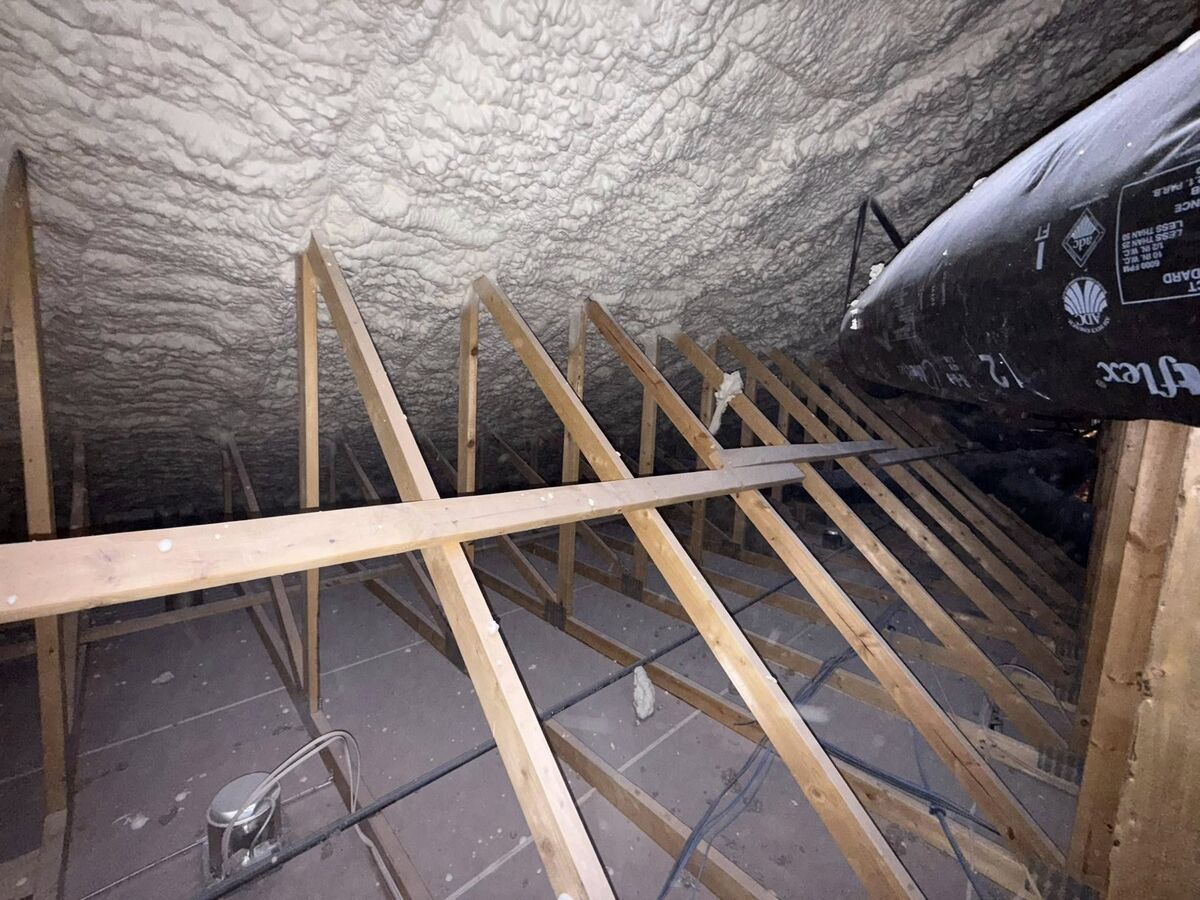
For the biggest result — and for homes where the attic is used for storage or the HVAC equipment lives up there — insulating at the roof deck with spray foam moves the thermal boundary from the attic floor to the roofline. The attic becomes conditioned-ish space: dramatically cooler, ducts inside the envelope, second-floor ceilings no longer under an oven. It is the most involved option and the one we quote after the attic walk, not before; our spray foam attic insulation page covers when it earns its price.
The honest order of operations
- Seal first — air leaks undo expensive insulation. This is the DOE's own sequencing.
- Then insulate to depth — blown-in top-up is the best cost-to-difference ratio in the whole house.
- Then consider radiant barrier or a foam roofline — the big levers, best chosen with the attic and duct layout in front of you.
What Insulation Will Not Fix
We would rather tell you this before the quote than after. Some hot-upstairs problems are mechanical, not envelope:
- Undersized or failing second-floor equipment. If the upstairs unit was marginal on day one, insulation will reduce the load but not replace the tonnage.
- Zoning and airflow balancing. A single thermostat downstairs deciding the fate of bedrooms upstairs will fight you all summer; dampers and register balancing are HVAC work.
- West-facing glass. An upstairs wall of west windows gains heat faster than any ceiling loses it. Shading and window work belong in the conversation.
If the upstairs problem is noise rather than heat — a different upstairs complaint we hear a lot — that is a different article: see our soundproofing guide for Arizona homes.
One more envelope note: a sealed, insulated attic changes how the house breathes, and that touches indoor air quality. We keep the EPA's indoor air quality guidance in mind on every sealing job, and we flag ventilation questions when we see them. Sealing a house is also a summer-health issue in this state — when the National Weather Service Phoenix office is issuing excessive-heat warnings, a second floor that actually cools at night is not a luxury.
How We Approach a Hot-Upstairs Job
We do not quote a fix for a hot second floor sight-unseen, because the same symptom comes from at least four different causes. We walk the attic, measure insulation depth, look at the duct runs, and check where the sun hits the house — then lay out the options in cost order with what each one will and will not change. The visit is free and the order of operations matters more than any single product choice. If you are ready to start, get a free estimate or call us at 623-241-1939, or use our insulation calculator to size the conversation. If the whole house is due rather than just the upstairs, our homeowner's insulation timeline guide walks through sequencing a full-envelope job.
Frequently Asked Questions
Why is my upstairs so hot even with the AC running? Because the heat is arriving faster than the upstairs system can remove it: a superheated attic conducts and leaks heat into the ceiling all day, and attic duct runs lose cooling capacity on the way. Envelope work (air sealing, attic insulation depth, duct sealing) attacks the load; equipment alone cannot.
Why is the second floor hotter at night? The attic stores the day's heat in the roof deck and framing and keeps radiating it down after sunset, while the stack effect keeps pushing warm air up from below. Air sealing and attic insulation are what change the overnight curve.
How much cooler can the upstairs actually get? It depends on how far the attic was from where it should be. A thin, leaky attic over the bedrooms is the biggest single heat-gain path in the house, so correcting it moves the needle more than any other envelope job. We would rather measure your attic and give you an honest range than quote a number we have not seen.
Does insulation in the attic really help the second floor more than the first? Yes — the second-floor ceiling is directly under the attic, so attic heat reaches those rooms first and hardest. First-floor rooms benefit too (less heat rising through the house), but the bedrooms over the staircase of heat gain see the biggest change.
Is a hot attic bad for anything besides comfort? Yes: it shortens roof and HVAC-equipment life and degrades anything stored up there. Attic ducts in a superheated attic also lose cooling capacity through their walls even when perfectly sealed.
Should I just close the downstairs vents to push air upstairs? Not without a professional look. Residential systems are balanced for their duct design; closing registers can raise static pressure and make the equipment work harder. Balancing dampers are the right tool, and they are an HVAC-technician job.
What is the R-value my attic should have in Arizona? Phoenix sits in a hot climate zone where attic levels are specified well above what many older Valley homes actually have. We measure your existing depth and compare it to the level for our zone as part of a free estimate — and by federal rule, any R-value claim comes with this disclosure: The higher the R-value, the greater the insulating power. Ask your seller for the fact sheet on R-values.
Will a radiant barrier replace attic insulation? No. A radiant barrier reflects radiant heat from the hot roof deck; bulk insulation slows conducted heat. In an Arizona attic they are complementary — we explain the division of labor in our radiant barrier guide.
Why are my upstairs rooms hotter than downstairs in winter too? The same stack effect — warm air collects upstairs — plus heat rising through unsealed ceiling penetrations. In winter the complaint inverts (upstairs too warm, downstairs chilly), and the same air-sealing work evens both seasons out.
Spray foam the roofline or blow insulation on the attic floor — which is better? It depends on where the boundary of the house should live: if the attic stays a vented, unoccupied space, insulate the floor; if the attic holds ducts and equipment or you want it usable, the foam roofline wins. That is exactly the decision we make on the attic walk, not from a price list.
How long does an attic top-up take? Most blown-in top-up jobs on a two-story Valley home are done in a day, with the depth verified as we go. Air sealing is often done the same visit, before the material goes in.